Get the Facts to the Responders

The responders may be paid professionals or volunteers. They are the people who crash participants need to summon in the quickest, most reliable way possible. The purpose of this project is to inform the responders of crash events directly, without delay, without error in fact.

Today, we have methods to notify responders of crashes. These methods rely upon people to relay the message. The 911 system and General Motors’ OnStar are familiar and admirable methods. They also share a common point of failure, the people.

A crash is a stressful, often disorienting event. Participants may not be able to accurately describe their locations and the crash environment. Bystanders may not be available or reliable. There may be language barriers. In short, people are generally great, generally well-intentioned and generally reliable. However, people can misunderstand each other. Even when people understand each other perfectly, it takes time to relay the information from bystander or participant to responder. Let’s improve upon that. This project will shrink that time to seconds.

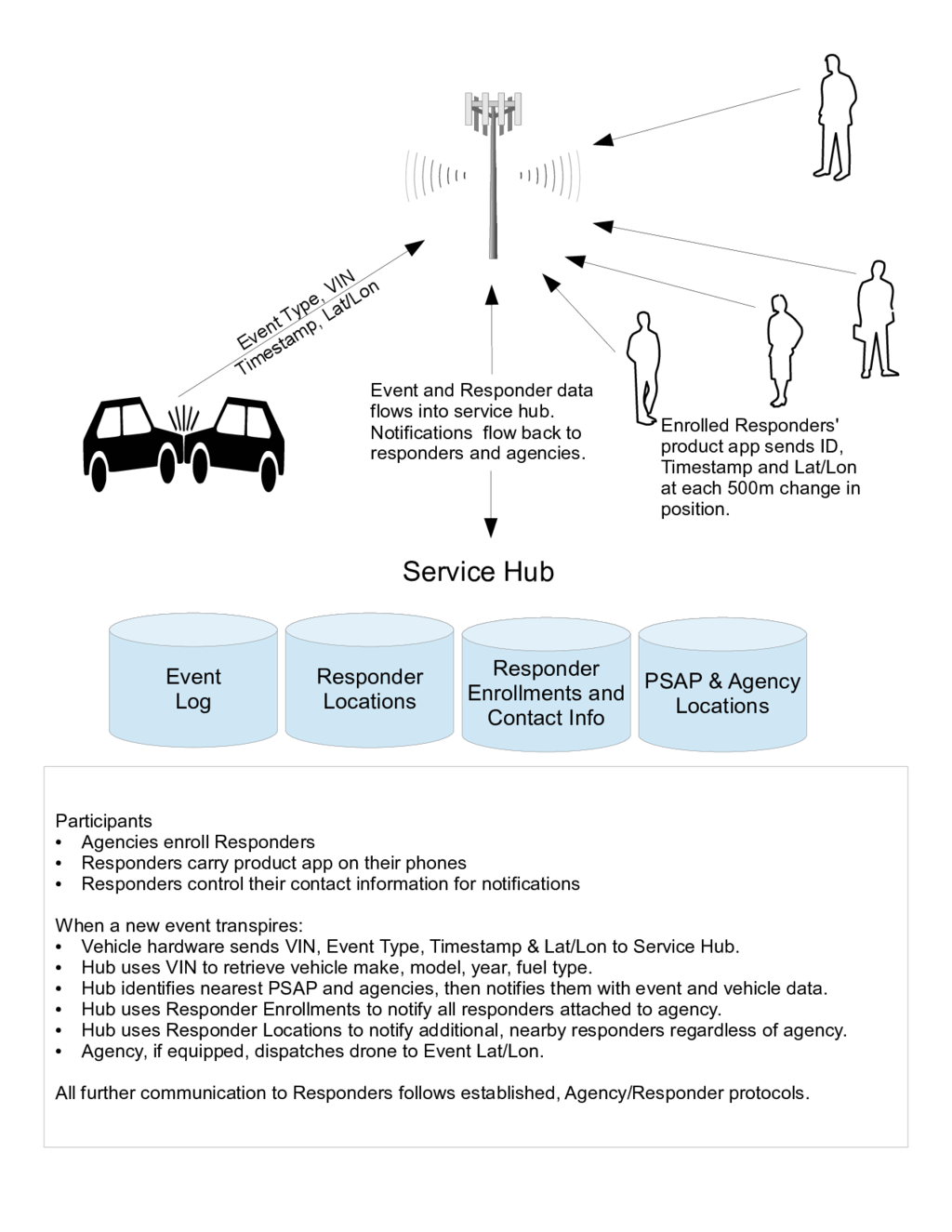
A notification from this project’s service hub will be delivered to the responders who are closest to the event. It will contain strictly the facts that are available from the vehicle’s telematics:

  • The exact time. (Always just moments ago.)
  • The location, available as data and easy to render upon a map.
  • The character of the crash that is available from the vehicle’s sensors such as, “Airbag Deployment.”
  • The nature of the vehicle which is automatically, immediately, available from the Vehicle’s Identification Number (VIN): Make, Model, Year, Fuel Type.

Put the Pieces Together

This project is dedicated to the present, where thousands of crashes happen each day. What more can we do to assist vehicle occupants and first responders?

Dedicated scientists, engineers, administrators and law enforcement officers are working diligently on crash prevention. The more completely their work bears fruit, the better. This project is about the meanwhile.

The purpose of the Incident to Response Design Project is to leverage existing data and current communication technology to make emergency incident response quicker and more robust. Recently built vehicles are capable of informing their manufacturers of mundane and catastrophic events. Most adults now carry a smartphone. Let’s do what we can, with what we have, where we are … now. Let’s put the pieces together.

Pay It Forward

This is a message directly to automobile manufacturers. Not all consumers love your “Infotainment” systems. Examine the comment section from a recent, Washington Post article about the contents of a 2017 Chevrolet Volt embedded computer.

The implication is clear. Your brand will suffer among consumers who understand how you have deployed your information gathering technology within their vehicles.

You can improve your standing. Break off a tiny, specific piece of the data you have been collecting, and share it with the Project. The Project only needs notification of instances where a vehicle has suffered a catastrophe, such as an airbag deployment. Catastrophes happen once or twice, at most, in the lifespan of a vehicle.

The Project isn’t your competitor. The Project doesn’t prevent you from selling your Customers’ data. The Project is simply a utility to reliably summon trained first-responders to catastrophic incidents involving your vehicles.

Consider the goodwill that will accrue when others learn that your vehicle was responsible for the speedy arrival of the first, first-responder. Consider the implication of not participating in The Project after other manufacturers choose to participate. The choice is yours. The Project encourages you to chose wisely.

The Connected Car

The connected car is the source of actionable crash notifications. Fortunately, connected cars, once obscure, are a rapidly growing segment of the fleet. In 2019, a projected 64 million connected cars will join the fleet.

The influence of these additional connected cars is more than proportional to their numbers. It’s simple math. An unfortunate fact is that many crashes involve multiple vehicles. Fortunately, only one of the involved vehicles needs to be a connected car for the crash to be reported by telematic means.

It’s important to repeat that this project is about speedy and robust response to a crash, not crash prevention. Crash prevention is everyone’s ultimate goal, but it will take time to achieve. Crash prevention will require ultra-low latency technology, such as a broad base of installed vehicle to vehicle DSRC and 5G connectivity. This project’s objective, speedy and robust crash response, can tolerate a moderate to low latency connection between car and service hub. 4G and LTE connections, available now, and in routine use, are more than adequate for this project.